

Each FOM is site-specific and built from low-impact materials like cardboard, bamboo, and scaffolding
Every event is curated to be inclusive, with an engaging community-focused approach that brings footfall to each space
Installations can last from days to months, depending on the brief
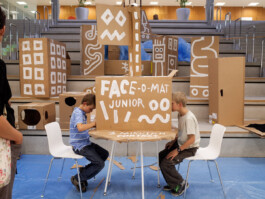
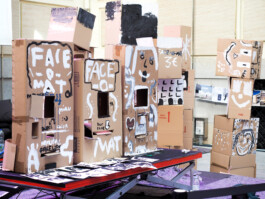
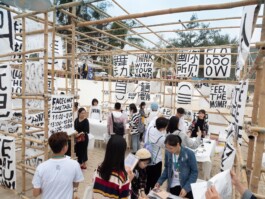
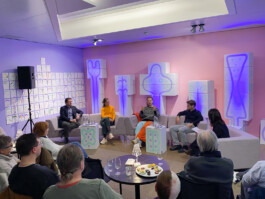
Once the Face-o-mat environment has been created, it is programmed and enlivened with school visits, workshops, talks and events. Workshops invite participants into a shared process of co-creation. Imaginative cardboard environments become temporary shelters and stages in an open and judgement-free atmosphere. Guided by curiosity and collective experimentation, the inclusive spaces create a connection grounded in Gutmann’s portrait practice.
Trained on thousands of portraits from a decade of human encounters, Sai Bot is Tobias Gutmann’s AI twin and can be programmed as part of the installations. Mirroring the gestures of seeing, translating and drawing through an algorithmic lense, Sai Bot extends the exploration of portraiture into the digital realm. → visit Sai Bot
*The AI that powers Sai Bot was developed by Dazlus in collaboration with Tobias Gutmann
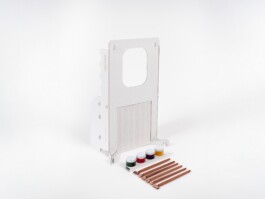
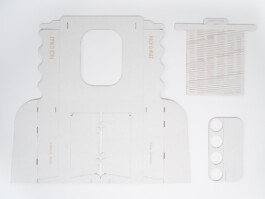
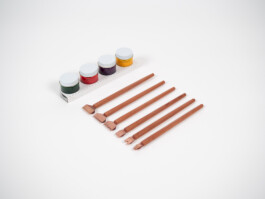
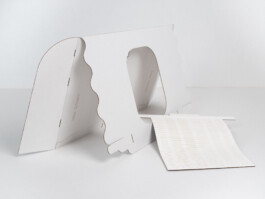
The Face-o-mat Kit invites the audience to interact. Co-hosted portrait drawing lessons expand the universe of Face-o-mat as part of the programme or at home, connecting audiences of all ages.
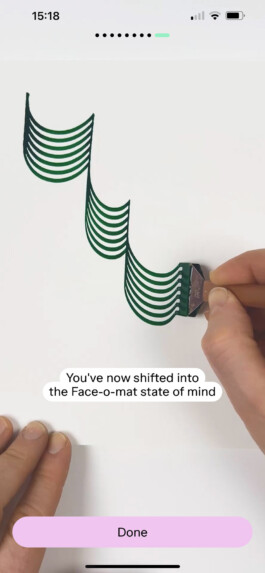
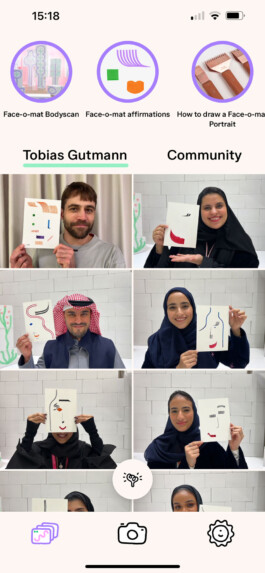
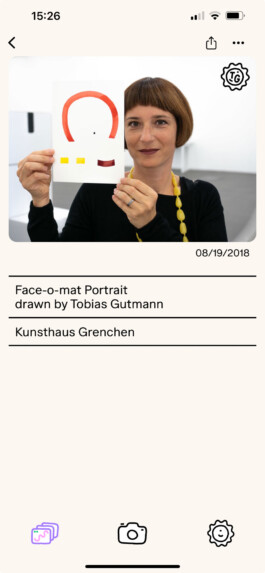
The app is the place to discover and learn about Face-o-mat. Lessons guide you step by step through the process of entering a Face-o-mat state of mind and drawing your own portraits. The portraits drawn can be documented with the in-app camera to become part of the growing archive. The app can also be used to collect portraits drawn by Gutmann.
How does Faceomat work?
Face-o-mat is a time-based drawing performance built on three elements: environment, encounter, and portrait.
A site-specific cardboard structure establishes an intimate setting that invites visitors to slow down and arrive. At the table, a Face-o-mat booth with a framed window hosts a 5–7-minute encounter in which artist Tobias Gutmann translates the visitor’s presence into an abstract portrait — a distilled memoire of meeting.
Over the years, Face-o-mat has expanded into studio formats where visitors draw each other or meet Sai Bot, its digital counterpart. Each portrait enters an ongoing archive, linking participants to a larger constellation of images and encounters. Within this space, practices of mindfulness, connection, and presence naturally unfold, inviting subtle reflections on embodiment, perception, and self-understanding.
Where did the idea come from, what was the inspiration?
The idea for Face-o-mat emerged from Tobias Gutmann’s intercultural upbringing and his search for ways to connect through drawing.
Growing up in Papua New Guinea and later living in Tanzania, Stockholm, and Switzerland, he was continually shaped by encounters across cultures. During his art studies, drawing became an immediate way to meet people in unfamiliar cities — an entry point into place and community.
From the beginning, the portraits were never intended as realistic depictions. Early experiments involved interpreting faces as animals, which gradually evolved into the abstract, iconic visual language that now defines Face-o-mat.
Is FOM the same every time or do you create a new environment for every installation?
Each Face-o-mat installation is a site-responsive iteration, developed in relation to its context and positioned as an intervention within the existing architectural environment.
Most installations are constructed from simple cardboard boxes that are painted and assembled into large-scale spatial environments. In outdoor settings, Gutmann has worked with bamboo structures or tent-like architectures using printed textiles. Across all formats, the emphasis remains on environmentally responsible materials and temporary, light-footprint constructions.
What does mindful dialogue mean?
In a world dominated by screens, face-to-face encounters are increasingly rare. Face-o-mat offers a counterpoint, honoring the human need to connect physically and in real time.
Drawing becomes the medium for a mindful dialogue. Time slows, attention sharpens, and neither artist nor participant knows what will emerge on paper. This uncertainty creates a subtle tension, inviting both to inhabit the moment fully, guided by intuition and subconscious choices. Participants often ask, “What should I do?” — the answer is nothing: simply being present is the practice. The act of waiting, of not knowing what happens on the other side, is an essential part of the encounter, before the finished portrait is revealed.
Through this attentive process, artist and participant engage in a dialogue that is always non-verbal and occasionally verbal, reflecting on presence, observation, and human connection.
How do you choose your materials and tools for a project?
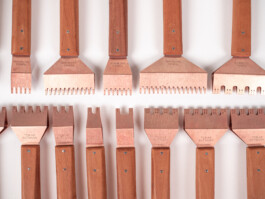
Tobias Gutmann crafts his own calligraphy tools, combining metal nibs with wooden handles, designed specifically to capture portraits in his abstract visual language. These tools are central to the practice of Face-o-mat, shaping both the gesture and the expression of each encounter.
The chosen paper format, 22 × 16 cm, is ideal for a 5–7-minute session: it allows sufficient detail to emerge while preserving intentional abstraction, ensuring that each drawing remains focused and contained within the time frame. The size also accommodates the tools’ distinctive technique, enabling continuous lines with a single dip of ink across the page, emphasizing presence, rhythm, and the mindful attention of the encounter.
What happens to the portraits afterwards?
For Tobias Gutmann, letting go of each drawing is an essential part of the Face-o-mat philosophy. Art, he believes, becomes truly valuable when shared; imbued with the story that surrounds it. Each sitter receives their portrait as a tangible memory of the encounter, a personal reflection of the moment shared. At the same time, the documented encounters enter the ongoing Face-o-mat archive, placing individual portraits within a larger constellation of images, connecting participants across time and place, while remaining available for exhibitions or curated presentations.
What happens to the installations afterwards?
Face-o-mat installations typically remain on site for 2–6 months. They are intentionally designed with sustainability in mind: cardboard components and other materials are repurposed or donated to charities, schools, or community projects, ensuring they continue to serve a purpose before ultimately being recycled. This approach reflects a commitment to environmentally responsible practices, minimizing waste and extending the life of each material, while honoring the ethos of temporary, mindful creation.
Where can I see FOM next?
Follow Face-o-mat and Tobias Gutmann on Instagram @tobiasgutmann and @faceomat to stay up to date, or subscribe to the newsletter for announcements about upcoming performances and installations.
How can I host Face-o-mat or order a kit?
Face-o-mat can be realized in multiple formats, adaptable to the character and scale of each space. Museums, institutions, and public spaces can host installations or exhibitions, from brief performances to immersive, site-specific experiences lasting several months. Each iteration is carefully curated to the space, inviting visitors into encounters that explore presence, observation, and connection. Alternatively, a Face-o-mat Kit allows for engagement in schools, museum workshops, or personal exploration. Contact the Face-o-mat team for guidance and support to ensure each experience remains faithful to the ethos and spirit of the project.

Each FOM is site-specific and built from low-impact materials like cardboard, bamboo, and scaffolding
Every event is curated to be inclusive, with an engaging community-focused approach that brings footfall to each space
Installations can last from days to months, depending on the brief
Once the Face-o-mat environment has been created, it is programmed and enlivened with school visits, workshops, talks and events. Workshops invite participants into a shared process of co-creation. Imaginative cardboard environments become temporary shelters and stages in an open and judgement-free atmosphere. Guided by curiosity and collective experimentation, the inclusive spaces create a connection grounded in Gutmann’s portrait practice.
Trained on thousands of portraits from a decade of human encounters, Sai Bot is Tobias Gutmann’s AI twin and can be programmed as part of the installations. Mirroring the gestures of seeing, translating and drawing through an algorithmic lense, Sai Bot extends the exploration of portraiture into the digital realm. → visit Sai Bot
*The AI that powers Sai Bot was developed by Dazlus in collaboration with Tobias Gutmann
The Face-o-mat Kit invites the audience to interact. Co-hosted portrait drawing lessons expand the universe of Face-o-mat as part of the programme or at home, connecting audiences of all ages.
The app is the place to discover and learn about Face-o-mat. Lessons guide you step by step through the process of entering a Face-o-mat state of mind and drawing your own portraits. The portraits drawn can be documented with the in-app camera to become part of the growing archive. The app can also be used to collect portraits drawn by Gutmann.
How does Faceomat work?
Face-o-mat is a time-based drawing performance built on three elements: environment, encounter, and portrait.
A site-specific cardboard structure establishes an intimate setting that invites visitors to slow down and arrive. At the table, a Face-o-mat booth with a framed window hosts a 5–7-minute encounter in which artist Tobias Gutmann translates the visitor’s presence into an abstract portrait — a distilled memoire of meeting.
Over the years, Face-o-mat has expanded into studio formats where visitors draw each other or meet Sai Bot, its digital counterpart. Each portrait enters an ongoing archive, linking participants to a larger constellation of images and encounters. Within this space, practices of mindfulness, connection, and presence naturally unfold, inviting subtle reflections on embodiment, perception, and self-understanding.
Where did the idea come from, what was the inspiration?
The idea for Face-o-mat emerged from Tobias Gutmann’s intercultural upbringing and his search for ways to connect through drawing.
Growing up in Papua New Guinea and later living in Tanzania, Stockholm, and Switzerland, he was continually shaped by encounters across cultures. During his art studies, drawing became an immediate way to meet people in unfamiliar cities — an entry point into place and community.
From the beginning, the portraits were never intended as realistic depictions. Early experiments involved interpreting faces as animals, which gradually evolved into the abstract, iconic visual language that now defines Face-o-mat.
Is FOM the same every time or do you create a new environment for every installation?
Each Face-o-mat installation is a site-responsive iteration, developed in relation to its context and positioned as an intervention within the existing architectural environment.
Most installations are constructed from simple cardboard boxes that are painted and assembled into large-scale spatial environments. In outdoor settings, Gutmann has worked with bamboo structures or tent-like architectures using printed textiles. Across all formats, the emphasis remains on environmentally responsible materials and temporary, light-footprint constructions.
What does mindful dialogue mean?
In a world dominated by screens, face-to-face encounters are increasingly rare. Face-o-mat offers a counterpoint, honoring the human need to connect physically and in real time.
Drawing becomes the medium for a mindful dialogue. Time slows, attention sharpens, and neither artist nor participant knows what will emerge on paper. This uncertainty creates a subtle tension, inviting both to inhabit the moment fully, guided by intuition and subconscious choices. Participants often ask, “What should I do?” — the answer is nothing: simply being present is the practice. The act of waiting, of not knowing what happens on the other side, is an essential part of the encounter, before the finished portrait is revealed.
Through this attentive process, artist and participant engage in a dialogue that is always non-verbal and occasionally verbal, reflecting on presence, observation, and human connection.
How do you choose your materials and tools for a project?
Tobias Gutmann crafts his own calligraphy tools, combining metal nibs with wooden handles, designed specifically to capture portraits in his abstract visual language. These tools are central to the practice of Face-o-mat, shaping both the gesture and the expression of each encounter.
The chosen paper format, 22 × 16 cm, is ideal for a 5–7-minute session: it allows sufficient detail to emerge while preserving intentional abstraction, ensuring that each drawing remains focused and contained within the time frame. The size also accommodates the tools’ distinctive technique, enabling continuous lines with a single dip of ink across the page, emphasizing presence, rhythm, and the mindful attention of the encounter.
What happens to the portraits afterwards?
For Tobias Gutmann, letting go of each drawing is an essential part of the Face-o-mat philosophy. Art, he believes, becomes truly valuable when shared; imbued with the story that surrounds it. Each sitter receives their portrait as a tangible memory of the encounter, a personal reflection of the moment shared. At the same time, the documented encounters enter the ongoing Face-o-mat archive, placing individual portraits within a larger constellation of images, connecting participants across time and place, while remaining available for exhibitions or curated presentations.
What happens to the installations afterwards?
Face-o-mat installations typically remain on site for 2–6 months. They are intentionally designed with sustainability in mind: cardboard components and other materials are repurposed or donated to charities, schools, or community projects, ensuring they continue to serve a purpose before ultimately being recycled. This approach reflects a commitment to environmentally responsible practices, minimizing waste and extending the life of each material, while honoring the ethos of temporary, mindful creation.
Where can I see FOM next?
Follow Face-o-mat and Tobias Gutmann on Instagram @tobiasgutmann and @faceomat to stay up to date, or subscribe to the newsletter for announcements about upcoming performances and installations.
How can I host Face-o-mat or order a kit?
Face-o-mat can be realized in multiple formats, adaptable to the character and scale of each space. Museums, institutions, and public spaces can host installations or exhibitions, from brief performances to immersive, site-specific experiences lasting several months. Each iteration is carefully curated to the space, inviting visitors into encounters that explore presence, observation, and connection. Alternatively, a Face-o-mat Kit allows for engagement in schools, museum workshops, or personal exploration. Contact the Face-o-mat team for guidance and support to ensure each experience remains faithful to the ethos and spirit of the project.